
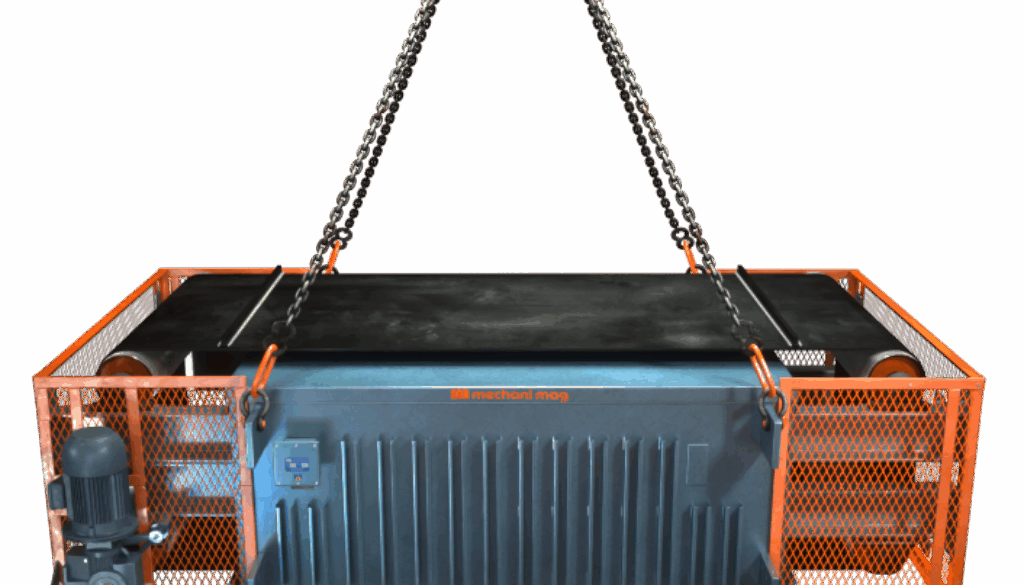
Self-Cleaning Magnets
The Latest Design Energy Efficient Dry Type Self Air Cooled Suspended Self Cleaner Belt Magnet Model 600OCB1800SAC represents the next step in magnetic separation technology. Built for heavy-duty performance and continuous operation, it combines energy savings, durability, and automated cleaning to keep production lines safe and efficient.
Self-cleaning magnets automatically remove tramp metal from product streams, protecting equipment, improving productivity, and reducing downtime.
How Self-Cleaning Magnets Work
Magnetic separation principle
Self-cleaning magnets operate on the principle of separating ferrous material from bulk product streams. As material moves along a conveyor belt, the magnet pulls iron fragments away from the flow. Nails, bolts, and shavings are held against the magnet surface while non-magnetic material continues forward. This simple action prevents contamination and keeps equipment downstream safe from unexpected damage.
The success of this separation lies in the strength and stability of the magnetic field. Inside the magnet box, aluminium coils are insulated with glass and nomex to withstand high temperatures and constant use. These coils generate a powerful, stable field that can operate continuously in harsh industrial environments. Because of this reliability, industries such as mining, cement, and processing facilities trust self-cleaning magnets to run without interruption, securing both product quality and worker safety.
Continuous belt system
Unlike traditional magnets that require manual cleaning, self-cleaning designs use a continuous belt system. This belt runs across the magnet face and transports collected ferrous fragments away from the field. The belt then discharges the captured material into a designated bin or chute. This process ensures that the magnet face remains clear and ready for new contaminants.
The system relies on pulleys, carbon steel shafts, and strong plummer blocks to maintain constant belt movement. Locking elements and crowned pulley designs keep the belt aligned, while durable belting material withstands heavy duty conditions. With the drive powered by a high-quality motor and gearbox, the belt moves smoothly and consistently. This continuous action means the magnet never becomes overloaded and production never has to stop for cleaning.
Role of self-cleaning mechanism
The self-cleaning mechanism removes the need for frequent manual intervention. In older systems, operators had to pause production, shut down equipment, and physically scrape ferrous material off the magnet. This was both time-consuming and unsafe. The automated belt does this work while the line continues running, saving hours of downtime each week.
In addition to reducing stoppages, the mechanism enhances safety. Workers no longer need to place themselves near strong magnetic surfaces or moving conveyor parts. This lowers the risk of injury while also improving consistency. A magnet that clears itself constantly maintains peak efficiency, never allowing ferrous material to build up and weaken the field. This results in better separation, lower repair costs, and uninterrupted productivity.
Core Components of a Self-Cleaning Magnet
Magnet box and casing
At the centre of the system is the magnet box, which houses the coils that generate the field. This box is built with thick steel and reinforced with lifting lugs for stability. It is designed to handle both mechanical stress and environmental exposure. The casing is precision-machined to protect the coils from dust, water, and vibration. By sealing the magnet in a rugged box, the system can function reliably in demanding industrial environments.
Stainless steel wear plates are used in high-contact areas to extend service life. The magnet is further protected by IP66-rated enclosures, which shield the coils from water and fine particles. This rating makes the magnets suitable for environments where jet spraying or high dust levels are present. The strong box construction is one of the main reasons these magnets can operate for decades with minimal servicing.
Conveyor belt and pulleys
The belt system is built from reinforced rubber or heavy-duty fabrics that can withstand long hours of use. Because the belt is in constant contact with metal fragments, it is designed for resistance against abrasion. Optional reinforced belting is available for applications where the load is exceptionally harsh.
The pulleys keep the belt aligned and moving. Four crowned pulleys, made from carbon steel, are fitted with locking elements and supported by plummer block bearings. This setup ensures smooth belt travel, reduces slippage, and keeps the belt stable during heavy loads. Adjustable tension systems allow operators to maintain belt alignment easily, ensuring continuous operation without unnecessary wear.

Bearings and drive system
The drive system includes a WEG IE3 motor coupled with a SEW gearbox, known for efficiency and durability. This combination delivers reliable power to the belt system while minimising energy consumption. By using efficient motors, the magnet lowers operating costs over time while still delivering maximum performance.
Bearings are equally important. They allow pulleys to rotate smoothly while handling the forces of constant belt tension. The design uses robust bearings that can manage both radial and axial loads. This reliability ensures that the belt system remains stable and requires little intervention, even under heavy material flow.
Guards and protective parts
Protective guards surround the moving sections of the magnet. These are made from expanded metal mesh that allows for inspection while preventing accidental contact with rotating pulleys or belts. Drive supports and structural reinforcements hold the magnet in place securely, even when it operates under continuous load.
Other protective parts include hooks, shackles, and mounting brackets, which make installation safe and stable. These parts are essential for positioning the magnet above conveyors or fitting it into limited spaces. Together, they provide both safety for operators and structural strength for the unit.
The Function of the Self-Cleaning Belt
Automatic removal of tramp metal
The belt continuously removes tramp metal captured by the magnet. As ferrous fragments are lifted out of the product stream, the belt carries them away to a safe discharge point. This automatic removal prevents recontamination of the material flow.
By ensuring that captured fragments are always cleared, the system maintains its magnetic strength. The process is simple but highly effective: the magnet captures, the belt transports, and the system discharges. This cycle repeats continuously, ensuring that no piece of ferrous material remains in the product flow.
Reducing downtime and manual cleaning
Without a self-cleaning belt, magnets require frequent manual cleaning. Each cleaning involves shutting down the line, exposing workers to potential risks, and wasting production time. With the automated belt, these stoppages are eliminated. The magnet cleans itself while production continues, delivering higher throughput and efficiency.
For industries that run around the clock, such as mining or cement production, the reduction in downtime translates directly into cost savings. Eliminating hours of lost productivity per week creates a clear return on investment. Over the long term, this advantage far outweighs the initial cost of installing a self-cleaning system.
Ensuring consistent magnetic performance
The belt prevents magnetic saturation, which occurs when ferrous fragments build up on the magnet surface. If this happens, the field strength weakens and separation becomes less effective. By continuously clearing the magnet face, the belt ensures that the field remains strong and consistent.
This consistent performance means fewer contaminants slipping through, reduced wear on downstream equipment, and a steady flow of clean product. In industries where even a single contaminant can damage equipment or compromise product safety, this reliability is invaluable.
Advantages of Self-Cleaning Magnets
Energy efficiency
Modern self-cleaning magnets are designed for low energy consumption. Advanced coil technology provides the same magnetic strength with half the electrical input of older systems. Operating at efficiency levels similar to IE4 standards, they cut electricity costs while maintaining powerful separation.
Energy efficiency also reduces environmental impact. Lower electricity use means fewer emissions and a smaller operational footprint. In industries that are increasingly conscious of sustainability, this feature is both practical and responsible.
Reduced maintenance
With automatic cleaning, maintenance demands are much lower. Operators do not need to stop production to clear metal, and components such as pulleys and belts are designed for durability. Monitoring systems alert staff to issues before they become serious, further reducing maintenance needs.
Over time, the lower maintenance requirements add up to major savings. Spare parts last longer, fewer man-hours are spent on servicing, and the overall operation runs more smoothly.
Long-term durability
Self-cleaning magnets are built with heavy-duty casings, reinforced belts, and stainless steel components. The IP66 protection keeps out dust and water, while coatings resist corrosion and wear. Optional certifications are available for hazardous environments, extending their suitability even further.
This durability ensures a long operational life with consistent performance. For industries investing in this technology, the magnet is not a short-term solution but a long-term safeguard for production.
Safety Features and Monitoring Systems
Belt-slip and tear detection
Self-cleaning magnets are fitted with systems that monitor belt condition in real time. Sensors detect slippage or tearing, which can occur under heavy load or when foreign material jams the belt. When an issue is found, the system triggers an alert or shuts down the drive before further damage occurs. This fast response prevents complete belt failure, reducing downtime and avoiding expensive repairs.
This feature is particularly valuable in industries where the magnet operates around the clock. A single belt tear can result in hours of lost production. By detecting issues early, operators can replace or repair belts during scheduled maintenance rather than in emergencies. The result is smoother operations, higher uptime, and lower overall costs.
Temperature monitoring with sensors
Another safety feature is the inclusion of PT100 temperature probes. These sensors measure the temperature inside the magnet casing, ensuring the coils remain within safe operating ranges. Overheating can damage insulation or weaken the magnet field, but continuous monitoring prevents this from happening.
Temperature monitoring also provides useful data for long-term planning. By analysing readings over time, maintenance teams can spot trends that may indicate coil wear or environmental stress. This proactive approach allows them to schedule service before serious problems develop. The ability to monitor temperature accurately is one of the reasons these magnets can operate reliably in harsh environments.
Protection in harsh environments
Self-cleaning magnets are designed for rugged use. The IP66 rating provides protection from dust and water, which means the units can be cleaned with high-pressure jets and still operate effectively. This makes them suitable for mining, quarrying, and cement plants where dust is unavoidable.
The casing and structural components are also built to withstand impact, vibration, and corrosive conditions. Internally welded lifting lugs add strength, while reinforced plates protect wear-prone areas. These design choices ensure that the magnet remains safe and functional even in the toughest operating environments.
Types of Self-Cleaning Magnets
Dry-type magnets
Dry-type designs eliminate the need for oil or fans. They use advanced coils and insulation to manage heat without liquid cooling. This reduces maintenance because there is no need to replace or filter oil. It also makes the magnet more environmentally friendly, since there are no fluids to manage or dispose of.
Dry-type magnets are also highly energy-efficient. Their design uses 50% less power compared to standard versions, while still providing the same magnetic strength. This balance of performance and efficiency makes them well suited to industries that want both cost savings and reliable separation.
Overband belt magnets
Overband designs are suspended above conveyor systems and continuously extract ferrous contaminants from moving material. The belt carries trapped metal to the discharge side, where it is safely released. These units are widely used in bulk handling industries because of their efficiency and ability to cover large conveyor widths.
The overband design is simple yet effective. By sitting directly above the conveyor, it intercepts contaminants before they enter processing machinery. This prevents costly damage and ensures that only clean material continues through the system. Their heavy-duty construction allows them to handle high throughput with little maintenance.
Low head-room designs
In facilities where space is limited, low head-room models are used. These units provide the same level of separation but are compact enough to fit into areas with restricted clearance. Their design allows for easy integration into existing conveyor systems without requiring major modifications.
This flexibility makes low head-room magnets ideal for retrofitting. Facilities that want the benefits of self-cleaning magnets but cannot afford to redesign their layouts can install these models quickly and gain immediate improvements in safety and efficiency.
Industrial Applications
Mining and quarrying
In mining, self-cleaning magnets are essential for protecting crushers, mills, and grinders from tramp metal. Large bolts or scrap iron mixed with ore can cause catastrophic equipment damage. By removing contaminants early in the process, magnets prevent breakdowns and keep operations running smoothly.
Quarries use them in the same way, placing them above conveyors that transport stone and aggregates. These environments are tough, with heavy dust and constant vibration, but the rugged construction of self-cleaning magnets allows them to perform reliably. Their role in preventing downtime makes them a standard part of modern mining operations.
Cement and aggregate plants
Cement plants handle vast quantities of raw material. Metal contamination not only threatens equipment but also risks compromising product quality. Self-cleaning magnets remove contaminants before material enters kilns or grinders, preventing damage and ensuring a purer product.
In aggregate plants, the magnets ensure that only stone continues through the process. Removing unwanted metal reduces wear on crushers and screens, which are expensive to repair. Continuous operation is critical in these facilities, making the self-cleaning mechanism particularly valuable.
Food and chemical processing
In industries where purity is vital, self-cleaning magnets help maintain strict quality standards. Food processors use them to ensure no fragments of machinery or tools end up in the final product. Chemical plants use them to protect sensitive processing equipment from contamination.
These industries demand reliability and cleanliness, both of which self-cleaning magnets provide. Their ability to operate without oil and their resistance to dust and water make them suitable for sterile or sensitive environments where contamination is unacceptable.
Recycling and waste handling
Recycling plants rely heavily on magnets to separate ferrous materials from waste streams. Self-cleaning designs improve efficiency by working continuously without interruption. This improves recovery rates and ensures valuable metals are not lost.
Waste handling facilities also benefit, as magnets protect shredders and compactors from tramp metal. By preventing damage, they reduce downtime and extend the lifespan of expensive equipment. The self-cleaning function allows these facilities to process large volumes of material quickly and efficiently.
Materials and Construction
Use of stainless steel and heavy-duty alloys
The choice of materials is crucial to the durability of self-cleaning magnets. Stainless steel is used in wear-prone areas for its resistance to corrosion, while heavy-duty alloys provide structural strength. This combination ensures that the magnet can handle both harsh environments and continuous loads.
By using strong materials, the magnets resist wear and maintain performance over long periods. This reduces the need for replacements and lowers total ownership costs. The robust construction is one of the main reasons industries can rely on these magnets for years without major servicing.
Coils and insulation design
Aluminium coils are widely used because of their ability to conduct electricity efficiently while staying lightweight. These coils are insulated with glass and nomex to withstand temperatures up to 180 °C. Wrapped in multiple layers, they resist breakdown under constant use.
This insulation ensures that the coils maintain their magnetic strength for longer periods. By protecting the most critical component, the magnet can continue to perform even under demanding conditions. This attention to detail in coil design is what separates advanced self-cleaning magnets from older models.
IP ratings and environmental protection
The IP66 rating confirms that the magnets are completely dust-tight and resistant to high-pressure water jets. This makes them suitable for harsh conditions such as cement plants, quarries, and mining sites. Operators can clean the equipment without worrying about damaging sensitive internal parts.
This level of protection is a major factor in extending service life. Magnets with lower ratings are more vulnerable to dust ingress and moisture, leading to coil damage and reduced performance. The high rating ensures long-term reliability in any environment.
Comparing Self-Cleaning Magnets to Manual Clean Options
Efficiency differences
Manual clean magnets require frequent stoppages so workers can remove trapped material. This interrupts production and reduces output. In contrast, self-cleaning magnets remove contaminants automatically, keeping lines moving without interruption. This difference in efficiency is the main reason industries choose automated systems.
The ability to run continuously provides a clear advantage in high-volume operations. Every hour of uninterrupted processing increases output, making self-cleaning magnets the obvious choice for facilities that handle large quantities of material daily.
Operational costs
While self-cleaning magnets may cost more to install, they quickly pay for themselves by reducing downtime and maintenance. Manual systems require more labour, increase the risk of accidents, and slow production. Automated systems minimise these issues and provide long-term savings.
The reduced energy use of modern designs further adds to the cost benefits. By consuming up to 50% less electricity, self-cleaning magnets lower ongoing expenses while still delivering strong performance. Over the life of the equipment, the savings are significant.
Suitability for different industries
Manual systems may still suit smaller operations with low throughput, but for large industries the self-cleaning option is far more practical. Mining, cement, and recycling facilities cannot afford the constant stoppages required for manual cleaning. For these environments, automated magnets are not just beneficial but essential.
The suitability of self-cleaning designs lies in their balance of efficiency, safety, and durability. Industries that require continuous operation will always benefit more from automated systems.
Installation and Operation
Positioning and mounting
Correct positioning is crucial for self-cleaning magnets to work effectively. Most are suspended above conveyor belts so that the magnetic field can intercept material as it passes underneath. The magnet must be aligned precisely with the product flow to capture contaminants efficiently. Incorrect placement can reduce effectiveness or allow fragments to pass through unnoticed.
Mounting systems are built with hooks, chains, and shackles, making installation flexible. The magnet can be fixed directly over the conveyor or mounted at an angle depending on the available space. For facilities with limited height, compact low head-room models can be fitted without extensive modifications. This adaptability allows industries to install self-cleaning magnets in both new and existing plants.
Drive and gearbox integration
The belt drive system relies on a combination of motor and gearbox to provide consistent movement. High-quality motors such as IE3 units are chosen for their efficiency, while gearboxes provide the torque needed to move the belt under load. These components work together to keep the belt speed steady, ensuring contaminants are discharged effectively.
The integration of motor and gearbox is engineered for reliability. By using robust couplings and alignment systems, the drive operates smoothly even under constant strain. This reduces wear on components and extends service life. Maintenance teams can also access the drive system easily for routine checks, making operation straightforward.
Flexibility in incline and orientation
One of the advantages of modern self-cleaning magnets is their ability to operate at different angles. They can be mounted flat, on an incline, or even upside down depending on the requirements of the plant. This flexibility allows them to adapt to conveyor systems of various shapes and layouts.
Being able to operate in multiple orientations makes the magnets suitable for facilities where space is restricted. They can be positioned in ways that traditional systems cannot, ensuring effective separation without costly redesigns. This adaptability is a major factor in their widespread use across industries.
Long-Term Benefits for Businesses
Cost savings through efficiency
By reducing downtime, self-cleaning magnets provide immediate cost savings. Production lines remain active while contaminants are removed automatically, eliminating the need for frequent stoppages. This improvement in efficiency directly increases output and profitability.
Energy-efficient designs also lower operating expenses. With modern coils reducing consumption by up to half, long-term savings on electricity are substantial. When combined with reduced maintenance needs, the overall cost benefits make these magnets an attractive investment for any high-throughput industry.
Increased equipment lifespan
Ferrous contaminants are one of the main causes of equipment damage in processing plants. By removing them early, self-cleaning magnets protect crushers, mills, grinders, and conveyors from serious wear and tear. This extends the lifespan of expensive machinery and reduces the frequency of costly repairs or replacements.
Protecting equipment not only saves money but also provides stability. Unplanned breakdowns can disrupt schedules and result in lost revenue. With self-cleaning magnets in place, businesses gain the confidence that their critical machinery is shielded from hidden dangers.
Reliability in continuous operations
Industries that run twenty-four hours a day depend on equipment that can match that pace. Self-cleaning magnets are built for continuous use, with features like IP66 protection, reinforced belts, and robust motors. This design ensures they can operate day and night without failure.
The reliability of these systems allows businesses to plan confidently. Production targets can be met consistently, and schedules are less likely to be interrupted by unexpected downtime. In industries where output levels are tied directly to revenue, this reliability is invaluable.
Common Misconceptions About Self-Cleaning Magnets
Assumptions about energy use
Some operators believe that self-cleaning magnets consume excessive amounts of power. This may have been true for older designs, but modern models are built for efficiency. By using advanced coils and insulation, they provide the same magnetic strength with far less electricity. This means they protect equipment effectively without driving up costs.
The misconception often comes from not accounting for the total savings. Even if the magnet uses some energy, the cost is far lower than repairing a damaged crusher or losing hours of production. When viewed in context, self-cleaning magnets are among the most cost-effective solutions available.
Misunderstanding of maintenance needs
Another common belief is that self-cleaning magnets still require constant maintenance. In reality, the automated belt system drastically reduces manual intervention. Routine checks are still necessary, but they are far simpler and less frequent compared to manual systems.
The inclusion of belt-slip detection and temperature monitoring further reduces maintenance needs. These features allow operators to identify and solve small issues before they become serious. The result is a system that is far less demanding on staff than many expect.
Clarity on operating environments
It is sometimes assumed that magnets can only operate in clean environments. The opposite is true. With IP66 protection and heavy-duty construction, self-cleaning magnets are designed for dust, moisture, and even direct jet spraying. They thrive in harsh conditions such as mining sites, cement plants, and recycling yards.
This misconception can discourage businesses from installing magnets where they are most needed. In reality, these systems are specifically engineered for tough environments and perform best under demanding conditions.
Future of Self-Cleaning Magnet Technology
Advancements in energy efficiency
Future designs are expected to push efficiency even further. Improvements in coil materials and motor technology will reduce energy consumption while maintaining strong fields. As industries seek greener solutions, energy-efficient magnets will become a standard requirement.
Lower consumption also makes magnets more accessible for facilities operating in regions with high electricity costs. The ongoing focus on efficiency ensures that these systems will continue to provide financial and environmental benefits.
Smarter monitoring systems
The future will also bring smarter monitoring. Integrating sensors with digital control systems will allow operators to track performance, belt wear, and coil temperatures in real time. Remote monitoring could become standard, allowing issues to be identified and resolved quickly.
This integration will improve reliability further, as predictive maintenance will replace reactive repairs. Plants will be able to plan servicing more accurately, reducing downtime and increasing efficiency.
Adapting to industry challenges
As industries process higher volumes of material, self-cleaning magnets will adapt with stronger belts, more compact designs, and advanced durability. Whether operating in limited spaces or handling extreme throughput, future models will be designed to meet these demands.
Their ability to evolve with industry needs ensures they will remain vital across sectors. By combining energy efficiency, smart monitoring, and adaptable construction, self-cleaning magnets will continue to protect equipment and support reliable operations.
The Latest Design Energy Efficient Dry Type Self Air Cooled Suspended Self Cleaner Belt Magnet Model 600OCB1800SAC showcases the strength of modern self-cleaning technology. This advanced design complements Mechani Mag’s other successful models, including the 300OCB900SAC, 400OCB1200SAC, 500OCB1500SAC, 550OCB1500SAC, and 550OCB1800SAC, each built to deliver reliable separation and long-term performance.
Looking for the Latest Design Energy Efficient Dry Type Self Air Cooled Suspended Self Cleaner Belt Magnet Model 600OCB1800SAC?
Get in touch with Mechani Mag today for specifications, expert assistance, and competitive quotes.
Tel: +27 11 397 6870
Cell: +27 65 732 6714
Emergency: +27 72 126 1099
Email: info@mecmag.co.za | sales@mecmag.co.za